
Currently Empty: $0.00
Year 4 Number and algebra WA4MNADE1 4 pages · 29 questions Core
Year 4 Reading & Writing Tenths Worksheet
Free Year 4 worksheet on reading and writing tenths as fractions and decimals, aligned to WA4MNADE1.
What's covered
- Converting between tenths as fractions (e.g. 7/10) and as decimals (e.g. 0.7)
- Comparing and ordering decimal tenths
- Applying tenths to real-world measurement and quantity contexts
About this worksheet
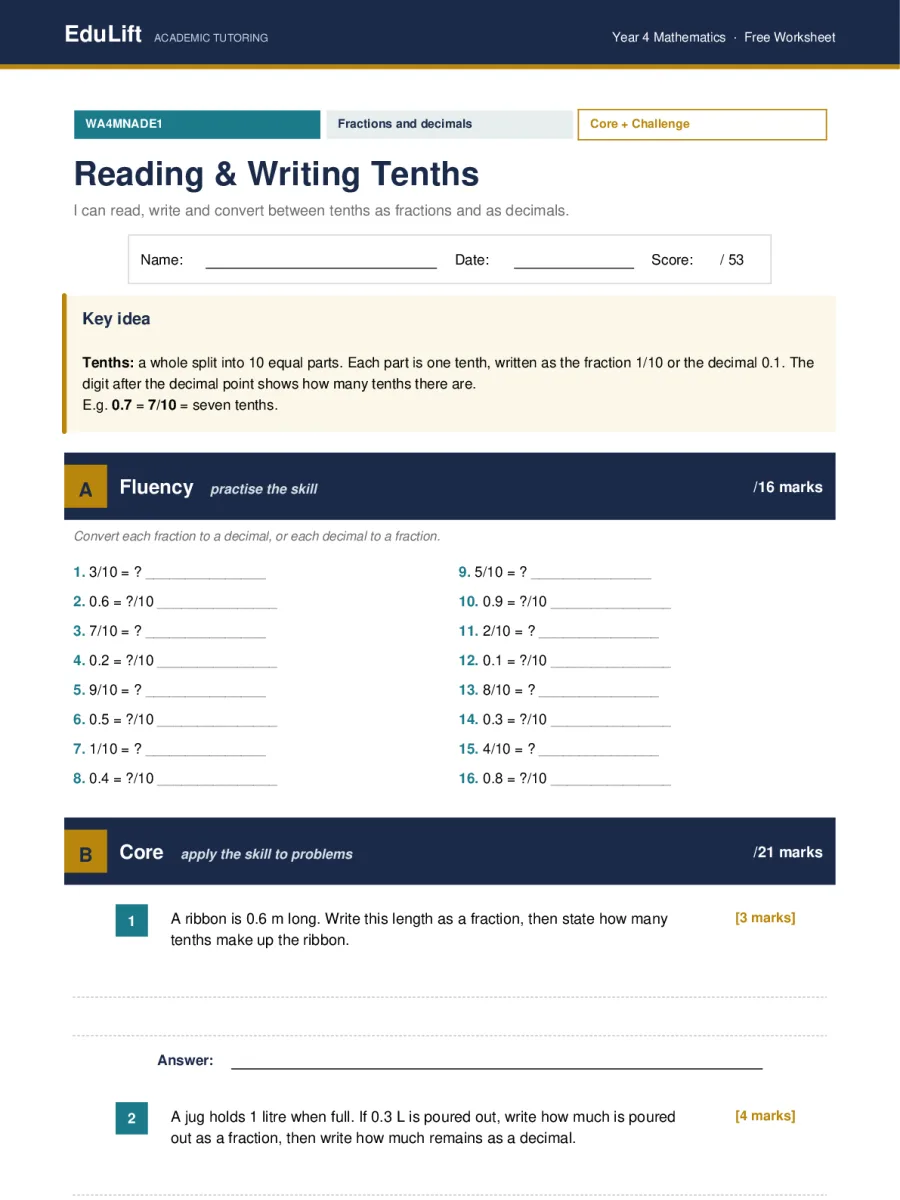
Tenths are students’ first formal introduction to decimals, and understanding the direct link between the fraction 7/10 and the decimal 0.7 is essential before moving on to hundredths and more complex decimal work. This worksheet builds that fraction-decimal connection through converting, comparing and applying tenths in context.
The worksheet follows EduLift’s standard four-part structure. It opens with 16 fluency questions converting between tenths as fractions and as decimals. Six core questions apply tenths to real contexts — ribbon lengths, jugs of water, race distances and tank capacities — several requiring a comparison or a calculation after the conversion. Four reasoning questions ask students to explain what the digit after the decimal point represents, correct a common misconception that confuses a decimal with a whole number, and evaluate a general claim about digit count and decimal size. Three challenge questions ask students to find a decimal within a range, solve for an unknown decimal, and combine two tenths amounts in a practical problem.
Every question and worked solution has been hand-checked for accuracy, and a full worked answer key is provided as a separate download, with clear marking guidance for the multi-step word and reasoning questions.
This worksheet is aligned to the WA Curriculum code WA4MNADE1 and is free to download for personal and classroom use.
Common errors we see in tutoring
- Confusing a decimal like 0.5 with the whole number 5
- Misreading the tenths digit when converting a fraction to a decimal or vice versa
- Assuming a decimal with more digits is always the larger number
- Errors adding or comparing tenths without converting to a common form first
Answer key (with worked solutions)
The answer key is a separate PDF with every question worked, not just the final answers.
Download the answer key (PDF)Stuck on a section? That's what our Year 4 tutors are for.
Book a free trial class and we'll show you exactly which skills to work on next.