
Currently Empty: $0.00
Year 4 Measurement and geometry WA4MMGME1 6 pages · 29 questions Core
Year 4 Perimeter of Composite Shapes Worksheet
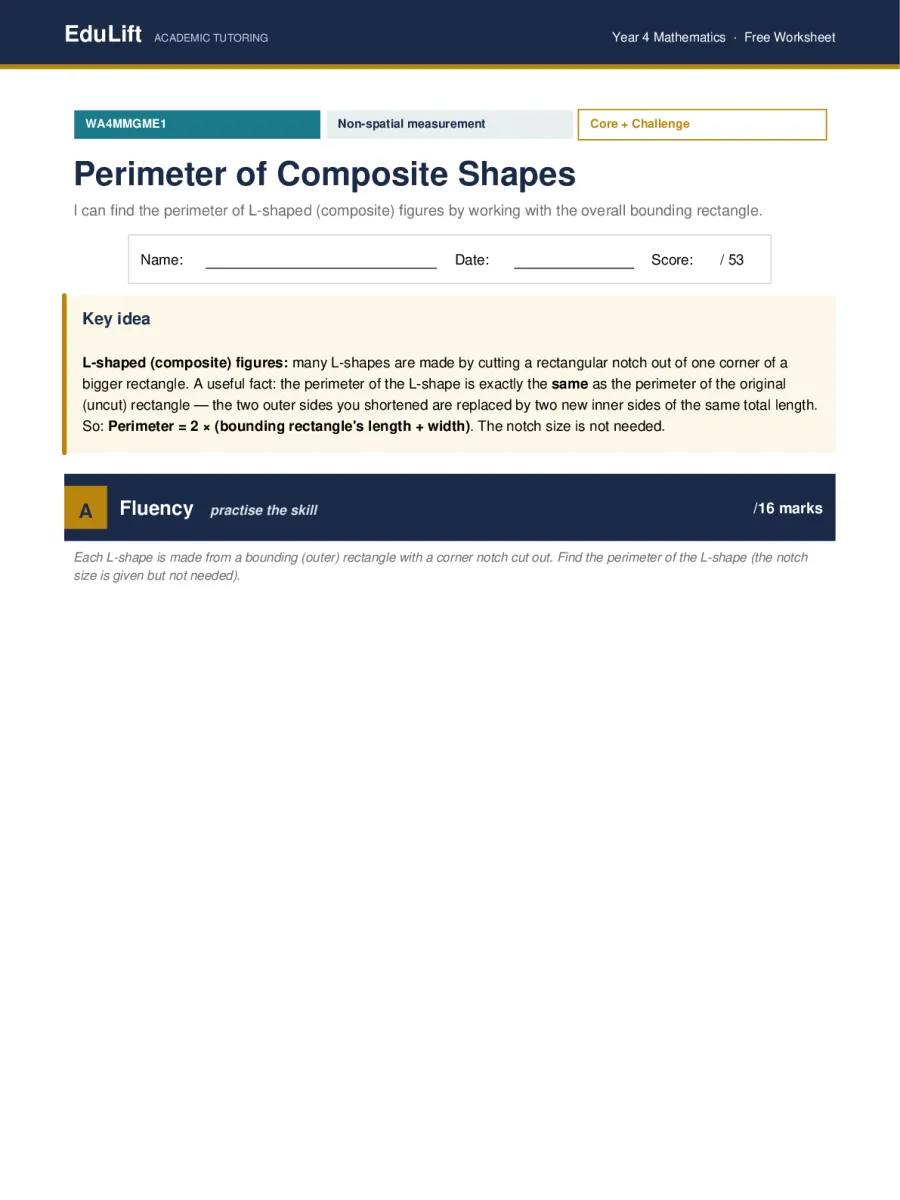
Free Year 4 worksheet on finding the perimeter of L-shaped (composite) figures, aligned to WA4MMGME1.
What's covered
- Finding the perimeter of an L-shape from its bounding rectangle
- Understanding why a corner notch doesn't change a shape's perimeter
- Applying composite-shape perimeter to real-world fencing, edging and cost problems
About this worksheet
L-shaped (composite) figures extend students’ perimeter skills to irregular shapes, and this worksheet focuses on the common “rectangle with a corner notch removed” case. Students learn the useful fact that cutting a rectangular notch from one corner of a rectangle does not change its perimeter, since the outer sides shortened by the notch are replaced by new inner sides of exactly the same total length.
The worksheet follows EduLift’s standard four-part structure. It opens with 16 fluency questions finding the perimeter of an L-shape from its bounding rectangle. Six core questions apply the skill to real contexts — parks, rooms, courtyards, sports fields, garden beds and patios — several requiring a second step such as a cost or a distance. Four reasoning questions ask students to explain why the notch doesn’t change the perimeter, correct a misconception about removed material always reducing perimeter, and describe the general method. Three challenge questions ask students to work backwards to find a missing side, and to extend the notch principle to two separate notches.
Every question and worked solution has been hand-checked for accuracy, and a full worked answer key is provided as a separate download, with clear marking guidance for the multi-step word and reasoning questions.
This worksheet is aligned to the WA Curriculum code WA4MMGME1 and is free to download for personal and classroom use.
Common errors we see in tutoring
- Trying to add or subtract the notch dimensions when they aren't needed
- Assuming removing material always makes the perimeter smaller
- Miscounting the sides of an irregular shape when a diagram isn't provided
- Using only part of the bounding rectangle's dimensions in the formula
Answer key (with worked solutions)
The answer key is a separate PDF with every question worked, not just the final answers.
Download the answer key (PDF)Stuck on a section? That's what our Year 4 tutors are for.
Book a free trial class and we'll show you exactly which skills to work on next.