
Currently Empty: $0.00
Year 4 Number and algebra WA4MNAFR1 4 pages · 29 questions Core
Year 4 Comparing & Ordering Fractions Worksheet
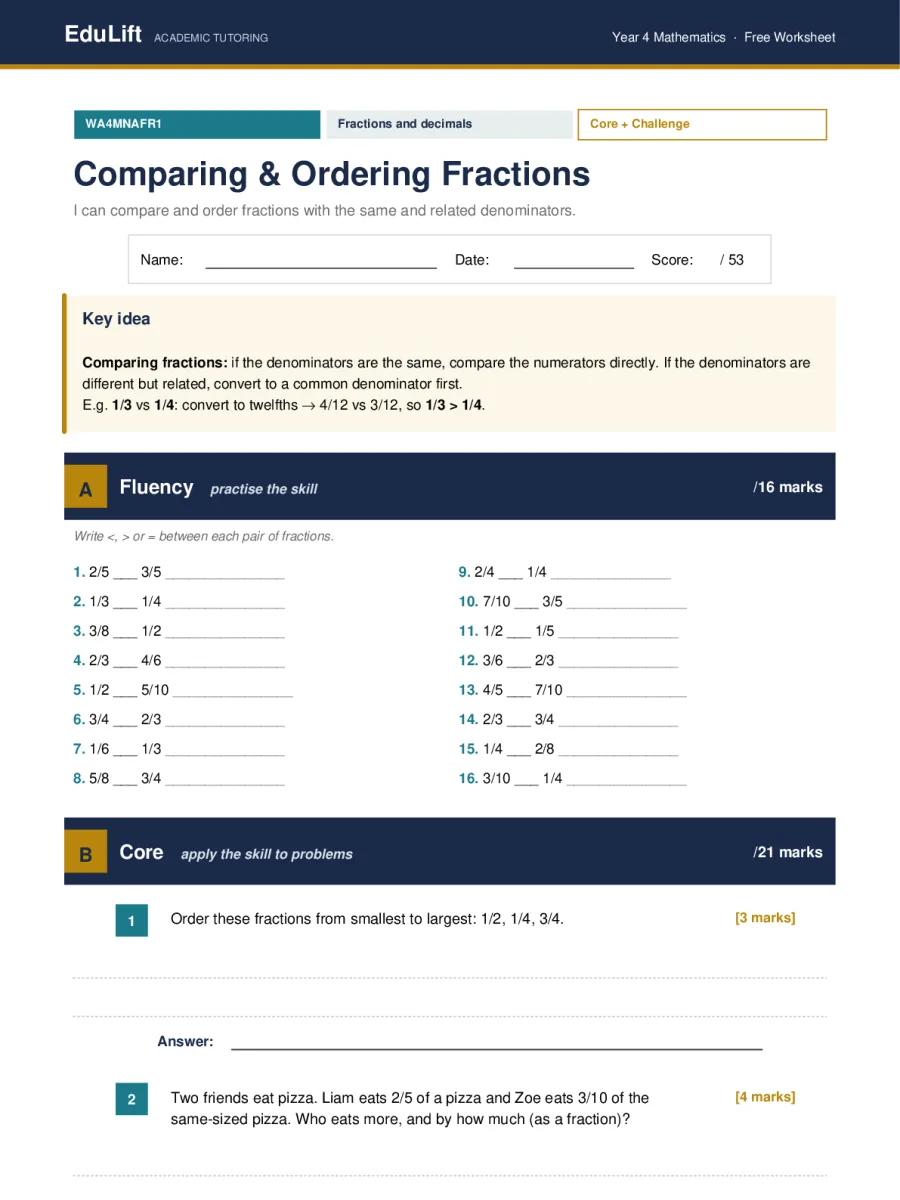
Free Year 4 worksheet on comparing and ordering fractions with the same and related denominators, aligned to WA4MNAFR1.
What's covered
- Comparing fractions with the same denominator by comparing numerators
- Converting fractions to a common denominator to compare or order related fractions
- Ordering three or more fractions from smallest to largest (or largest to smallest)
About this worksheet
Comparing fractions with the same and related denominators asks students to combine two skills at once — finding a common denominator and then judging relative size — and it’s a common stumbling block without plenty of guided practice. This worksheet builds that fluency step by step, from direct comparisons with matching denominators through to multi-fraction ordering with related denominators.
The worksheet follows EduLift’s standard four-part structure. It opens with 16 fluency questions using <, > or = to compare fraction pairs. Six core questions apply comparing and ordering to real contexts — sharing pizza, paint quantities and race completion — requiring students to find a common denominator and justify their answer. Four reasoning questions ask students to explain why a common denominator is needed, correct a common misconception about denominator size, and evaluate a general claim about ordering by numerator alone. Three challenge questions ask students to find a fraction between two given fractions, order four fractions with different denominators, and compare three quantities using a shared denominator.
Every question and worked solution has been hand-checked for accuracy, and a full worked answer key is provided as a separate download, with clear marking guidance for the multi-step and reasoning questions.
This worksheet is aligned to the WA Curriculum code WA4MNAFR1 and is free to download for personal and classroom use.
Common errors we see in tutoring
- Comparing numerators directly when the denominators are different
- Believing a larger denominator always means a larger fraction
- Choosing an incorrect (non-common) denominator when converting for comparison
- Misordering when more than two fractions are involved, due to arithmetic slips
Answer key (with worked solutions)
The answer key is a separate PDF with every question worked, not just the final answers.
Download the answer key (PDF)Stuck on a section? That's what our Year 4 tutors are for.
Book a free trial class and we'll show you exactly which skills to work on next.