
Currently Empty: $0.00
Year 4 Measurement and geometry WA4MMGTI1 5 pages · 29 questions Core
Year 4 Classifying 2D Shapes by Properties Worksheet
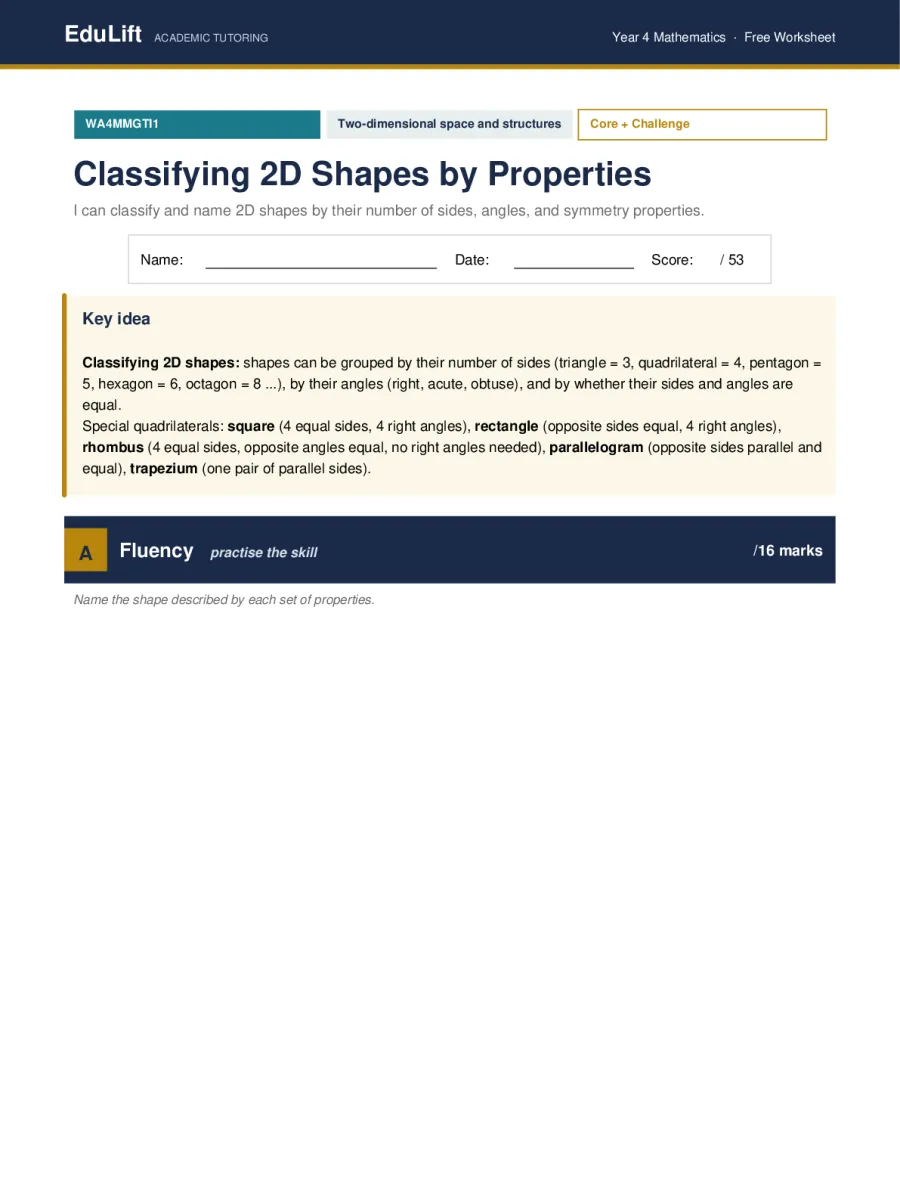
Free Year 4 worksheet on classifying and naming 2D shapes by their sides, angles and properties, aligned to WA4MMGTI1.
What's covered
- Naming 2D shapes by their number of sides, angles and equal-side properties
- Distinguishing special quadrilaterals: square, rectangle, rhombus, parallelogram, trapezium
- Understanding how shape classifications relate (e.g. every square is a rectangle)
About this worksheet
Naming and classifying 2D shapes by their sides, angles and symmetry is a key Year 4 geometry skill, and the special quadrilaterals in particular — square, rectangle, rhombus, parallelogram and trapezium — are a common source of confusion. This worksheet builds students’ ability to identify shapes from their properties and to understand how shape categories relate to one another.
The worksheet follows EduLift’s standard four-part structure. It opens with 16 fluency questions naming a shape from a set of given properties. Six core questions apply the skill to sorting, comparing and describing shapes, including distinguishing a square from a non-square rectangle and a rhombus from a parallelogram. Four reasoning questions ask students to explain why every square is a rectangle, correct a misconception about rhombuses and parallelograms, and evaluate a general claim that four equal sides always means a square. Three challenge questions ask students to name a shape from a partial set of properties, identify a polygon by its side count, and work through a full shape-classification hierarchy.
Every question and worked solution has been hand-checked for accuracy, and a full worked answer key is provided as a separate download, with clear marking guidance for the multi-step and reasoning questions.
This worksheet is aligned to the WA Curriculum code WA4MMGTI1 and is free to download for personal and classroom use.
Common errors we see in tutoring
- Assuming a shape with 4 equal sides must be a square
- Thinking a rhombus cannot also be a parallelogram
- Confusing a rectangle and a rhombus as the same category (rather than overlapping only at the square)
- Mixing up classification by sides (equilateral/isosceles/scalene) with classification by angles
Answer key (with worked solutions)
The answer key is a separate PDF with every question worked, not just the final answers.
Download the answer key (PDF)Stuck on a section? That's what our Year 4 tutors are for.
Book a free trial class and we'll show you exactly which skills to work on next.