
Currently Empty: $0.00
Year 4 Measurement and geometry WA4MMGAN1 4 pages · 29 questions Core
Year 4 Classifying Angles Worksheet
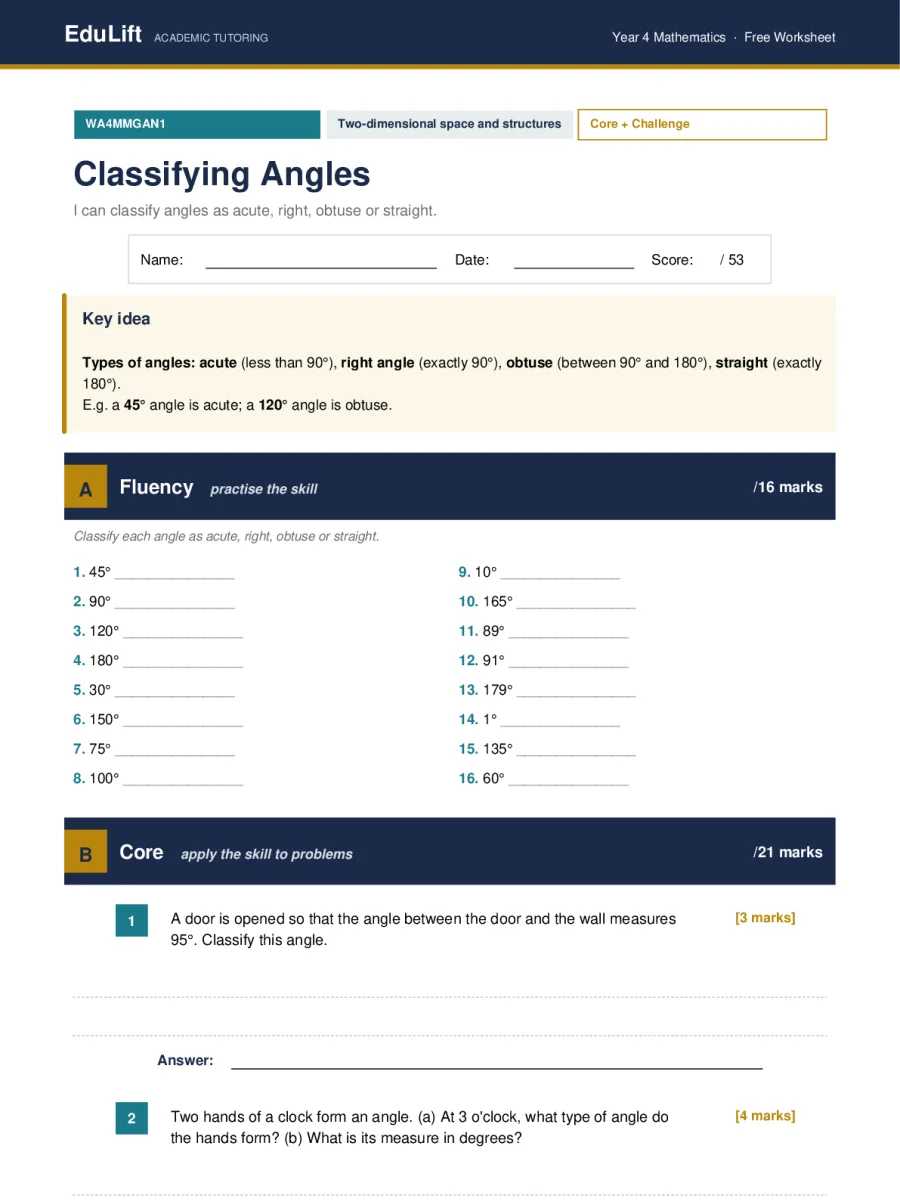
A free Year 4 maths worksheet on classifying angles as acute, right, obtuse or straight, with 29 questions across four skill levels.
What's covered
- Classifying angles as acute, right, obtuse or straight by their degree measure
- Calculating the number of degrees needed to reach a right or straight angle
- Applying angle classification to everyday objects and situations
About this worksheet
Classifying angles is a foundational Year 4 geometry skill that students will build on throughout their study of shapes and measurement. This worksheet gives students focused practice identifying whether a given angle is acute, right, obtuse or straight based on its degree measure.
The worksheet follows EduLift’s four-part structure, with 29 questions worth 53 marks in total. The Fluency section (16 marks) has students classify angles from 1° to 180°. The Core section (21 marks) applies this skill to real-world contexts such as doors, clock hands, ramps and scissors, including two-part questions that ask students to calculate how many more degrees are needed to reach a right or straight angle. The Reasoning section (9 marks) asks students to explain the difference between angle types, correct a common misconception about right angles, and justify why an obtuse angle isn’t automatically a straight angle. The Challenge section (7 marks) extends students with angle-calculation puzzles.
Every question and answer on this worksheet has been checked for accuracy, and the worksheet has been reviewed for clear layout and age-appropriate language before publishing.
This worksheet is aligned to the WA SCSA Mathematics curriculum for Year 4, under the Measurement and Geometry strand (code WA4MMGAN1), and is free to download and use for classroom or home practice.
Common errors we see in tutoring
- Classifying a 90° angle as acute instead of right
- Confusing obtuse and straight angles
- Assuming any angle bigger than a right angle must be a straight angle
- Miscounting the degrees needed to reach the next angle type
Answer key (with worked solutions)
The answer key is a separate PDF with every question worked, not just the final answers.
Download the answer key (PDF)Stuck on a section? That's what our Year 4 tutors are for.
Book a free trial class and we'll show you exactly which skills to work on next.