
Currently Empty: $0.00
Year 4 Measurement and geometry WA4MMGME1 5 pages · 29 questions Core
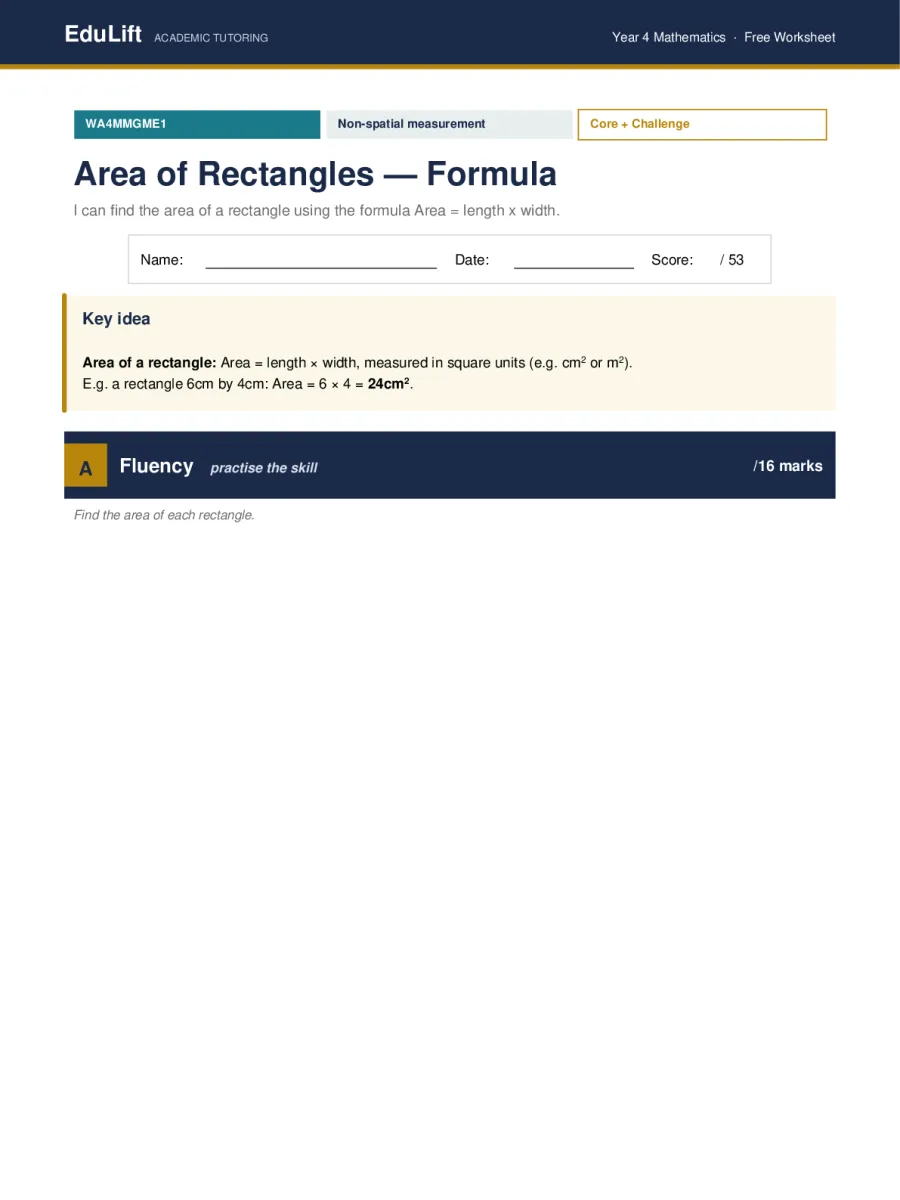
Year 4 Area of Rectangles — Formula Worksheet
Free Year 4 worksheet on finding the area of rectangles using the length x width formula, aligned to WA4MMGME1.
What's covered
- Finding the area of a rectangle using Area = length x width
- Applying the area formula to real-world cost, material and covering problems
- Working backwards from a known area to find a missing length or width
About this worksheet
Area = length x width is one of the most-used formulas in primary maths, underpinning everything from flooring and painting to gardening and packaging. This worksheet gives students focused practice applying the formula directly, then using it in real-world contexts and working backwards to find a missing dimension.
The worksheet follows EduLift’s standard four-part structure. It opens with 16 fluency questions finding the area of given rectangles. Six core questions apply the skill to real contexts — classrooms, gardens, posters, pools, vegetable patches and walls — several requiring a second step such as a packet, tin or cost calculation. Four reasoning questions ask students to explain why area uses multiplication rather than addition, correct a common misconception that confuses area with perimeter, and evaluate a general claim about doubling length. Three challenge questions ask students to work backwards to find a missing dimension, match areas between a square and a rectangle, and solve a multi-step ratio problem.
Every question and worked solution has been hand-checked for accuracy, and a full worked answer key is provided as a separate download, with clear marking guidance for the multi-step word and reasoning questions.
This worksheet is aligned to the WA Curriculum code WA4MMGME1 and is free to download for personal and classroom use.
Common errors we see in tutoring
- Adding length and width instead of multiplying them
- Confusing area (square units) with perimeter (a single length)
- Forgetting to convert units consistently before multiplying
- Assuming doubling the length always doubles both dimensions (not just one)
Answer key (with worked solutions)
The answer key is a separate PDF with every question worked, not just the final answers.
Download the answer key (PDF)Stuck on a section? That's what our Year 4 tutors are for.
Book a free trial class and we'll show you exactly which skills to work on next.